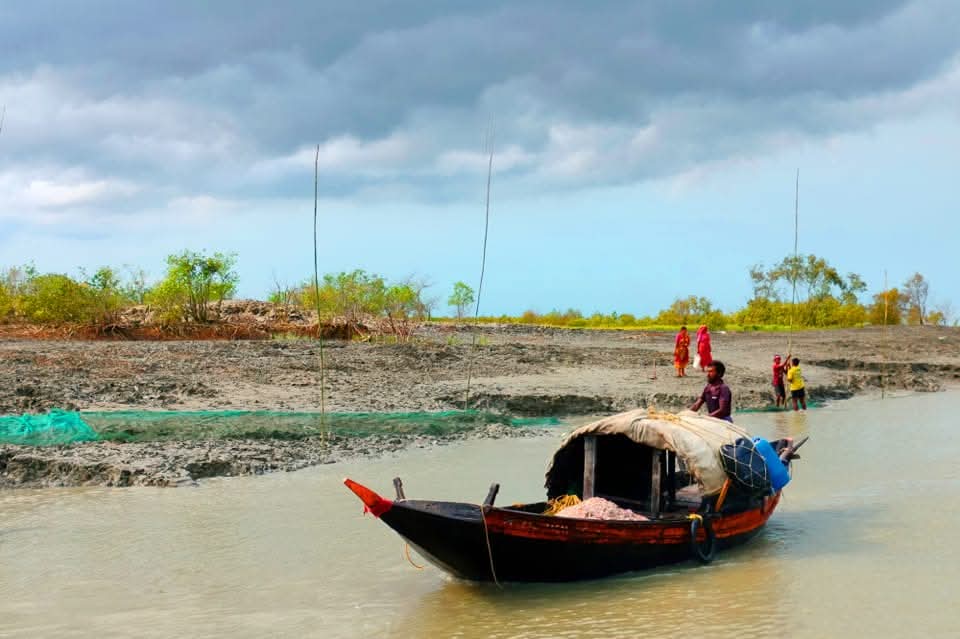
The Siren of Shankhachur: An Inspector Rudra Investigation
A chilling winter wind rattled the brick-and-stone cages of Kolkata when Inspector Rudra Narayan Chowdhury received an urgent summons. His destination: a remote, inaccessible area of the Sundarbans known locally as ‘Shankhachur Doha’ (The Conch Devil’s Pool), under the Sajnekhali Range. Over the last few new moon nights, several fishermen and honey collectors had vanished from this pool and its surrounding creeks. A preliminary investigation from the Lahiripur police station had yielded no answers. The Forest Department’s beat office confirmed it wasn’t a tiger attack—no bodies or even a trace of them had been found. Instead, a disturbing pattern emerged: before disappearing, each victim had reportedly heard a strange, ghostly “call” that pierced the silence of the night. Lalbazar had sent Rudra to unravel the mystery.
Rudra’s companion was Haripad Pramanik, a senior constable from the Lahiripur outpost and a walking encyclopedia of the region. As their government launch chugged towards Shankhachur Doha, Haripad stared apprehensively at the churning river.
“Sir, this place is not right,” he said, his voice low. “Even the forest guards avoid this pool. The water here is heavy, the air is still. And the night calls… they say it’s the ‘Bagho Haak’.”
“The ‘Bagho Haak’?” Rudra asked, his curiosity piqued. “What’s that?”
Haripad lowered his voice further. “It’s the call of the souls of those who die an untimely death in the jungle, sir. Their spirits can’t find peace. They wander the waterways, calling out to the living, looking for companions. Anyone who hears that call loses their senses and is pulled towards the water.”
Though Rudra was a man of logic, the genuine fear in Haripad’s voice gave him pause.
They reached Shankhachur Doha as evening fell. It was a massive river bend where multiple smaller creeks converged, creating a labyrinth of thick mangrove, Garan, and Bayan trees. Even in daylight, the place felt suffocating. Rudra learned that the last group to disappear was a team of honey collectors. Their boat, the ‘Ma Shitala’s Blessing’, had been found abandoned at the mouth of a narrow creek.
The next morning, Rudra and Haripad went to inspect the boat. Inside, rice, lentils, cooking utensils, and empty honey jars were scattered about, but there were no signs of a struggle. The sleeping area under the canopy was undisturbed. The only thing out of place was a strange, sickly-sweet, rotten smell clinging to the air.
One member of the missing team, a man in his forties named Nonigopal Das, had survived. He was still in shock, but when he recounted the events of that night, Rudra’s brow furrowed in thought.
“Sir, it was a new moon night,” Nonigopal began, his eyes wide with terror. “We had anchored in the pool after a long day of collecting honey. After dinner, as is the rule, we doused the lantern and moved the boat into open water to avoid attracting tigers. Around midnight, a sound woke me. It was a voice, coming from outside the boat, calling my name in a soft, fine tone. At first, I thought I was dreaming. But that voice… it was so strange… it had a pull, sir. I couldn’t resist.”
He continued, “I went outside and saw no one. Just fog and black water. But the call… it was coming from a little distance away, from the direction of the jungle. My three companions—Madhu, Kesto, and Panchu—they were already outside, entranced. I begged them not to go, but they wouldn’t listen. They got into our small dinghy and rowed towards the sound. I was too scared to follow. A little while later, I heard a loud, gurgling splash… then, complete silence. I searched all morning, sir. I never found the dinghy, or them.”
“What did the call sound like, Nonigopal?” Rudra asked, staring into the man’s eyes. “Was it an animal? Or a person?”
Nonigopal shook his head frantically. “No, sir, not an animal. It was like a human cry, but… but there was a strange melody mixed in it. It sounded like someone taking their last, gasping breath… yet the tune was so sad, so beautiful, it made you want to go to them, to ease their pain.”
The next day, Rudra, Haripad, and two armed forest guards set out in their launch, venturing into the cursed pool. Following Nonigopal’s directions, they navigated through creeks that grew progressively narrower, the dense jungle leaning over the water. Suddenly, Haripad raised a hand, his experienced eyes fixed on something floating near the bank.
Rudra looked through his binoculars. The broken prow of a small dinghy was caught in the reeds. Beside it, on the muddy bank, were strange tracks—round, flat, and very deep, as if a heavy, soft-bodied creature had slithered out of the water and back in.
“Nonigopal wasn’t lying,” Rudra said, his face grim. “Something terrifying happened right here.”
As they moved further, the sickly-sweet smell intensified, now mixed with the faint, coppery scent of blood. Following the odor, they arrived at the mouth of a wider creek where the water was calmer. And then they heard it. The ‘call’. At first, it was faint, a mournful tune drifting on the wind. Then it grew clearer, more hypnotic. A broken, sorrowful voice singing a lament:
“Oh, who are you, brother, out on the water…
My lonely tears flow, will you not answer…
My cool water bed awaits, my heart longs for a friend…
Come, let me embrace you, and your thirst will end…”
The faces of Rudra’s companions turned white with fear. “The Bagho Haak!” Haripad whispered.
Rudra gestured for them to be ready as he steered the launch silently towards the sound, which seemed to be coming from a dense thicket of bushes. With his revolver in hand, he switched on the launch’s powerful searchlight. As the beam cut through the darkness and illuminated the thicket, even the hardened detective felt his blood run cold.
There, coiled on the muddy bank, was a massive python. But it was far larger than any normal python, its body abnormally bloated. Its skin was a dark, swampy green, covered in algae and muck. Parasitic plants grew from its body like it was an ancient, submerged tree trunk that had just surfaced. And from its horrifyingly wide-open mouth, the hellish song was emanating. Scattered around it were the grisly remains of its victims: human skeletons, torn clothes, and fishing nets.
Rudra understood instantly. This water devil lured its prey with a siren’s call, then dragged them into its watery abyss. The monster likely lay dormant underwater for long periods, only surfacing to hunt.
Blinded by the searchlight, the python’s song stopped. Its two violet eyes glowed like embers. With an angry, guttural hiss, it began to heave its massive body, a putrid stench washing over them.
“Haripad! Forest guards! Fire!” Rudra yelled. “Aim for its head, its eyes!”
A volley of shots echoed through the night, but the python’s hide was too thick. The bullets only enraged it. It slid into the water and swam towards the launch, its cavernous mouth open in a silent, furious roar.
Realizing they couldn’t win this way, Rudra ordered the launch to pull back. His mind raced, trying to figure out how to turn the monster’s trap against it. He remembered the powerful harpoon gun stored on the launch, used for crocodile or shark infestations.
The python thrashed in the water, hissing in fury. Rudra kept the launch at a safe distance, observing. He noticed the creature would occasionally raise its massive head from the water, as if scanning for its prey. That was his chance.
Haripad readied the harpoon. After a tense wait, the python raised its head again. In that precise moment, Haripad fired. The sharp harpoon shot across the water and embedded itself deep inside the creature’s open mouth.
The python let out a tremendous, agonized shriek unlike anything they had ever heard. Its vast body thrashed violently, churning the water into a frenzy. The forest guards quickly secured the harpoon’s thick rope to the launch.
Then began a battle of wills: the primal power of a water devil against human ingenuity. The python tried repeatedly to drag the launch under, but slowly, its strength began to wane. After what felt like an eternity, the water grew calm. The massive, lifeless body of the python floated on the surface, a stream of blood flowing from its mouth.
Later, at the Sajnekhali Range Office, a post-mortem revealed the remains of the missing men inside the creature’s stomach. Experts identified it as a rare species of aquatic python capable of creating complex vocalizations to lure its prey. The parasitic plants on its body served as perfect camouflage. The ‘Bagho Haak’, the ghostly call of the dead, was nothing more than the hunting song of this horrifying creature.
As Inspector Rudra Narayan Chowdhury wrote his final report back in Kolkata, the events of that night replayed in his mind: the siren’s call, the monster’s final shriek, and the tragic fate of its victims. He knew that deep in the Sundarbans, under the water and in the dark heart of the jungle, countless other unknown dangers lurked. And the souls of those who fell victim to them might just return on new moon nights, not as ghosts, but as haunting legends—a timeless warning of nature’s primitive, ruthless power.
 Samiran Mandal