
Explore the fascinating world of Pirenella incisa, a unique mud snail from the Sundarbans mangroves. Learn about its sharp-tipped shell, habitat, and vital role in the ecosystem as a member of the Potamididae family.
The Sharp-Tipped Survivor: Meet Pirenella incisa, the Unsung Hero of the Sundarbans
When we think of the Sundarbans, our minds often conjure images of majestic tigers and sprawling mangrove forests. But the true health of this UNESCO World Heritage Site lies in its incredible biodiversity, much of which goes unnoticed on the glistening forest floor. It is here, in the rich, silty mud, that we encounter one of the ecosystem’s most vital engineers: the Pirenella incisa snail.
During a recent survey in the Kultali area, specifically at a location called Banchapri, we observed this remarkable species in its natural habitat. This small marine gastropod is more than just a creature; it’s a living indicator of the mangrove’s vitality.
What is Pirenella incisa? A Closer Look at the Horn Snail
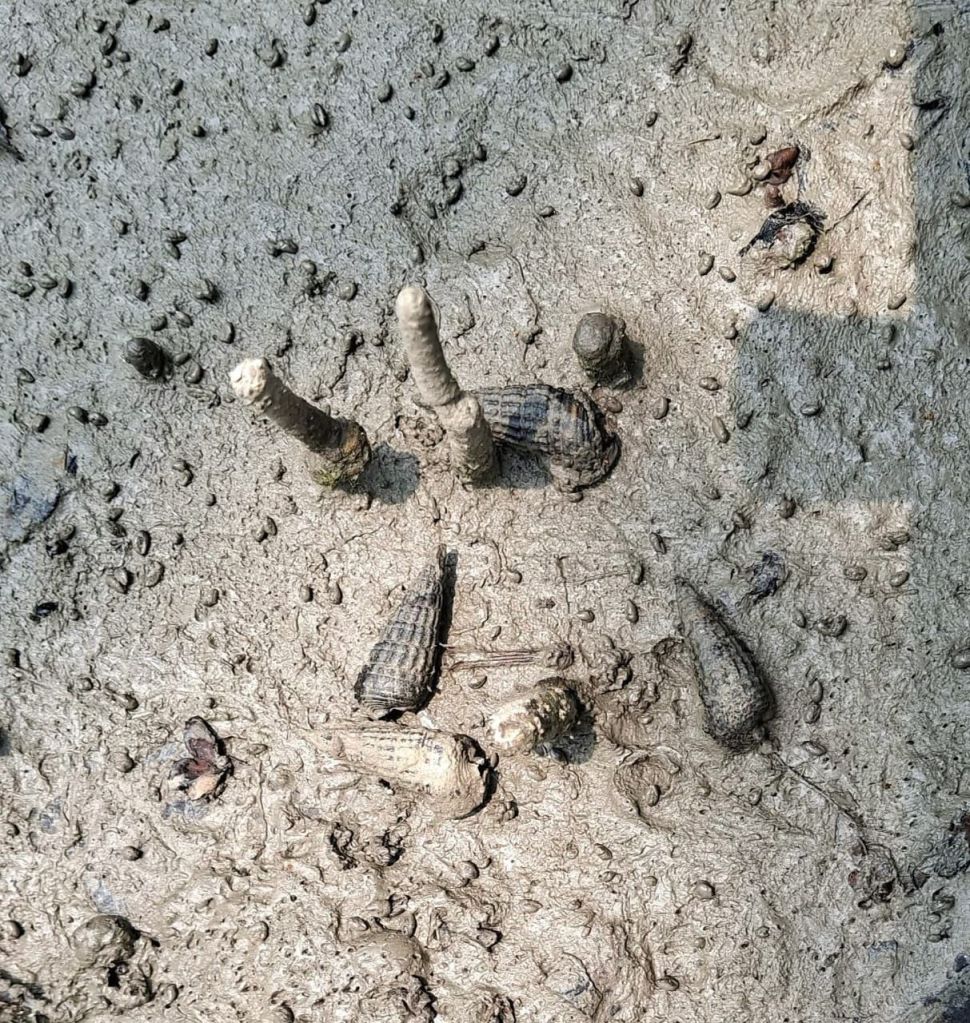
Pirenella incisa is a medium-sized sea snail, belonging to the Potamididae family, commonly known as the “horn snails.” This name is fitting, given their characteristic elongated, conical shells. The species name, incisa, points to one of its most defining features: a sharp, incisory tip at one end of its shell, which contrasts with a flattened base designed for stability on soft ground.
This unique shell isn’t just for defense; it’s a masterclass in adaptation, perfectly suited for a life spent navigating the challenging terrain of the mangrove floor.
The Perfect Habitat: Thriving in the Mangrove Intertidal Zone
To understand Sundarbans snails like Pirenella incisa, you must understand their home. They are specialists of the intertidal zone, the dynamic area between high and low tide. As both an arboreal (tree-dwelling, on lower trunks) and epibenthic (living on the substrate) species, their presence is a sign of a healthy, functioning mangrove ecosystem.
You can find these hardy snails in various micro-habitats:
- On Exposed Mud Flats: Gliding across the mud during low tide, feeding on algae and organic matter.
- Around Tree Bases: Congregating in soggy puddles near the roots of mangrove trees.
- In Adjoining Creeks: Thriving in the thickets and vegetation that line the waterways.
Their ability to move between the mud and the lower parts of the trees allows them to maximize feeding opportunities while avoiding predators like birds and crabs.
[Image: A close-up of the Pirenella incisa snail on the wet mud of the Sundarbans mangrove forest, showing its sharp-tipped shell.]
The Ecological Role of a Mud Snail: Why Pirenella incisa Matters
Though small, the ecological role of Pirenella incisa is immense. As a detritivore, it acts as a crucial part of the mangrove’s “clean-up crew.” It feeds on detritus—fallen mangrove leaves, algae, and other decaying organic materials. By consuming and breaking down this matter, it accelerates nutrient cycling, returning vital minerals to the soil.
This process is fundamental to the entire mangrove ecosystem. Without detritivores like this mud snail, organic waste would accumulate, depleting oxygen from the soil and harming the very trees that define the landscape.
A Tale of Coexistence: Pirenella incisa and Pirenella cingulata
One of the most exciting findings from our trip to Banchapri was observing Pirenella incisa in co-occurrence with a close relative, Pirenella cingulata. Finding two species from the same genus living side-by-side in large numbers is a strong indicator of a stable and resource-rich environment. It suggests that the habitat is healthy enough to support multiple specialized species, likely through subtle differences in their feeding habits or micro-habitat preferences, a phenomenon known as niche partitioning.
In conclusion, Pirenella incisa may not have the fame of the Sundarbans’ larger inhabitants, but its importance cannot be overstated. This sharp-tipped horn snail is a testament to the resilience and complexity of life in the mangroves. By understanding and protecting these smaller species, we safeguard the health of the entire ecosystem for generations to come.
 Samiran Mandal
9 responses to “The Sharp-Tipped Survivor: Discover the Secrets of the Sundarbans’ Horn Snail”
How unusual. They’re beautiful though, all god’s creatures.
LikeLike
Yes thanks 🙏
LikeLike
Samiran — I love how you give weight to what most would overlook.
The way you honor the quiet laborers of the mangrove feels almost sacred.
The world needs more eyes that see like this.
Do you think humility might be nature’s finest adaptation?
LikeLike
Maybe and thanks for your valuable comments 🙏
LikeLiked by 1 person
Thank you for shedding light on the “unsung hero.” The sharp-tipped survivor is clearly a powerful symbol of the complexity and resilience found at the intertidal zone. Good one Samiran 👏🏻👏🏻😇
LikeLiked by 1 person
How & Why the idea of healing meditation?
Emotions incite reactional “knee jerk” “non brain thought out” actions. The art of developing empathy simply does not depend upon feeling pity for someone or some thing. Men tend to stop maturing emotionally at about Age 16. Emotional retards till they get married and they encounter and live with a woman who bounces off the walls every time she experiences her bleeding period! And then come the ensuing children consequent to the marriage!
At that moment or thereabout enlightenment shines upon Mankind and they come to realize their disability of being an emotional retard. Only this revelation pushes a boy to grow into a Man. Meditation spins around the central axis of Chi directed through the exhale at some targeted audience; something like Yaacov sending a מלאך unto the Army lead by Esau; or HaShem sending Moshe as his מלאך sent unto Par’o and Egypt commanding that the Chosen Cohen People rejoice in their liberation from oppressive judicial corruption/slavery.
The inhaled breath during meditation focuses awareness of feeling through the 3rd eye. Indian meditation techniques refer to this 3rd eye awareness as “mindfulness”. Trauma at youth causes repression of emotions — removed from conscious contemplations. These subsumed emotions result in non-conscious reactionary behavior patterns. Something like a child witnessing or experiencing his father beating his mother or himself repeatedly. Later in life as an adult this same child tends to duplicate family violence which he\she experienced in his youth as a child.
Hence the central axis of 3rd eye meditation tends to strive during the interval wherein a person in-hales breath within their lungs, for that person to strive to uncover a repressed emotional trauma experienced during his youthful childhood life experiences with family members and friends. Contrast the exhale blowing of the Chi energy directed into a meridian point expressed, for example, through giving a Shiatsu Massage. A person breaths the Chi energy into the exact meridian point of a specific meridian line. Whereas the next exhaled breath might make the explosion of its Chi spirit energy directed as some opposing (think bi-polar battery) meridian point/line. Such a message aims to release emotional powers which amplify physical message manipulations of the muscles of the client message patient.
LikeLike
The Sundarbans truly is a magical realm where nature’s wild beauty and mystery come alive, every word sparks the thrill of adventure and deep respect for this incredible green lung of our planet.
LikeLike
Sparks curiosity
LikeLiked by 1 person
Thanks
LikeLike