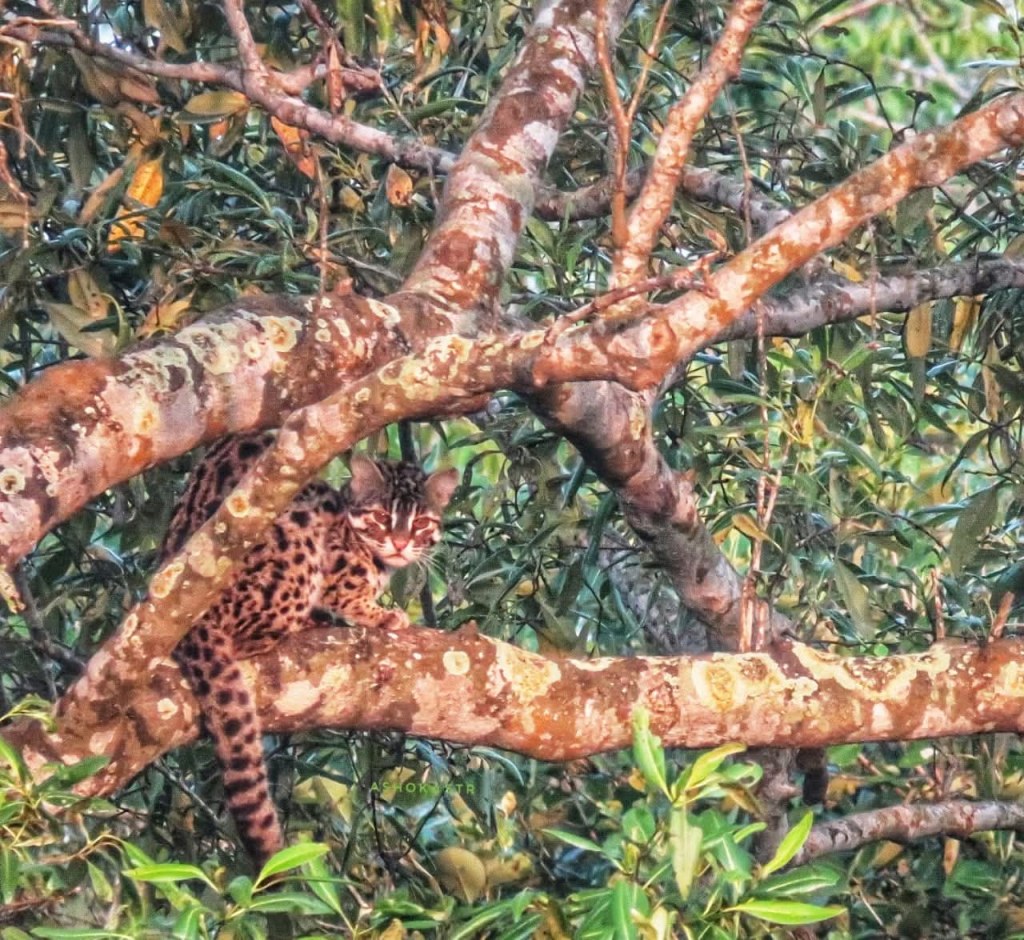
When we think of the Sundarbans, the majestic Royal Bengal Tiger usually dominates the narrative. However, hidden within the dense mangroves and breathing roots (pneumatophores) resides a smaller, equally enigmatic predator: the Leopard Cat (Prionailurus bengalensis).
Recently, the discovery of rare Melanistic (Black) Leopard Cats in the Raydighi range has sparked a new wave of scientific curiosity and conservation efforts.
Why is the Leopard Cat in the News?
While conducting the Tiger Census 2024-2026, camera traps captured rare footage of dark-furred Leopard Cats in the Dhulibhasani, Herobhanga, and Ajmalmari areas. This has prompted the Forest Department to plan a specialized study focusing exclusively on these lesser cats starting in January 2026.
Beyond the Tiger: Customized Camera Trapping
Standard camera traps are set at a height optimized for tigers. To study the Leopard Cat’s ecosystem, forest officials are now “customizing” camera placements. This will allow researchers to capture the arboreal (tree-dwelling) movements and ground activities of these elusive felines.
Key Characteristics of the Leopard Cat
1. Striking Appearance and ‘Rosettes’
The Leopard Cat is roughly the size of a domestic cat but with a more slender build and longer legs. Its coat is adorned with black spots known as ‘Rosettes’. Distinct black and white stripes run from the forehead to the neck, ending in a thick, ringed tail that is nearly half its body length.
2. Adaptation: The Master Swimmer
Living in the world’s largest mangrove forest requires unique skills. Leopard Cats possess webbed feet, making them excellent swimmers. This adaptation allows them to hunt for fish and crabs in the saline waters of the Sundarbans.
3. Solitary and Shy Nature
Excluding the mating season, these cats are fiercely solitary. They are nocturnal hunters, most active between 7 PM and 3 AM.
The Science of Melanism: A ‘Genetic Bottleneck’?
The most intriguing aspect for scientists is the rise of the Melanistic Leopard Cat. While a dark coat can be a natural genetic variation, it often points toward a ‘Genetic Bottleneck’.
- What is a Genetic Bottleneck? It occurs when a small population breeds within a limited range, leading to a lack of genetic diversity.
- The Goal: Researchers want to determine if these black cats are a sign of a shrinking gene pool or a successful adaptation to the deep, dark shadows of the mangrove forest.
Habitat and Diet: What Do They Eat?
Unlike the Fishing Cat (West Bengal’s state animal), which primarily eats fish, the Leopard Cat has a diverse diet:
- Rodents and small mammals
- Birds and insects
- Amphibians and crabs
They are perfectly adapted to both arboreal (trees) and terrestrial (ground) lifestyles, often seen sunbathing on tree branches during winter low tides.
Conservation Status and Future
Currently listed as ‘Least Concern’ on the IUCN Red List, the Leopard Cat still faces threats from habitat loss and climate change. With an estimated global population of 50,000, specialized studies in the Sundarbans are vital to ensure their survival for future generations.

 Samiran Mandal