The Passur Tree (Xylocarpus): A Complete Guide to the Sundarbans’ Sturdy Mangrove
Introduction: The Familiar Face of the Mangroves
Passur is a familiar face of the Sundarban mangroves. This tree belongs to the Meliaceae Family and the Xylocarpus Genus. A tree of medium height and thick girth, it is a key species of the unique mangrove ecosystem. Five species under the Xylocarpus Genus are found in Asia, Oceania and East Africa, with the Sundarbans housing a couple of these species.
Habitat and Distribution
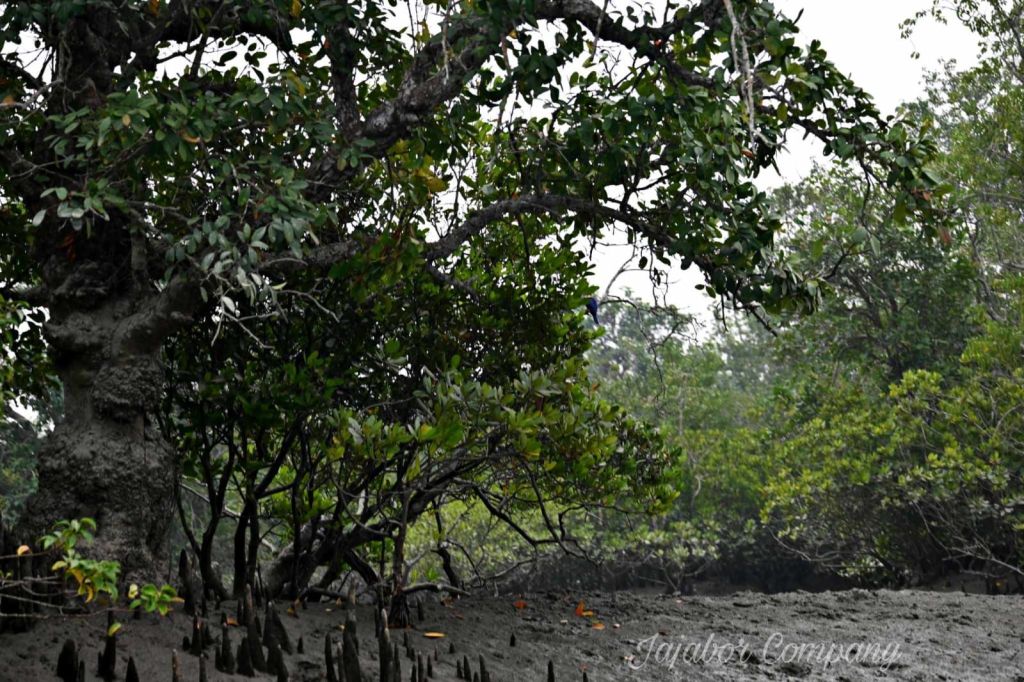
The Passur tree thrives in regions of medium as well as high salinity. It is found across the Sundarbans in varying densities, often located in canal interiors and on low-lying land that is diurnally inundated by high tides. It tends to prefer patches with a decent play of light, opting for not-too-dense thickets. The forests of the northern and central parts of the Indian Sundarbans host good populations of the Passur, where it is often found alongside ‘Keora’, ‘Bain’ and ‘Dhundhul’ trees.
Physical Characteristics
Size and Leaves: The Passur tree grows up to heights of thirty to forty feet. The leaves are bright, smooth, and a deep shade of green. They are compound leaves, blunt-tipped and oblong with six ligules on its tip.
Flowers and Fruits: The tree sheds its leaves in winter, and springtime sees the coming of new leaves. This is also the flowering time. The flowers are small, perfumed, and grow in a cluster or inflorescence of ten to thirty-five flowers, which can be about eight centimetres long. Flowers are unisexual and possess bilateral symmetry. The fruit is spherical with a flatness on the top and bottom. When ripe, the fruit is green with an orange inside, containing eight to ten fleshy, triangular or irregularly shaped seeds.
Roots, Bark and Wood: The tree is easily identified by the sharp, spear-shaped, conical, and ridged pneumatophores (breathing roots) around its base, which can be difficult to navigate. The tree bark is dark brown, rough, and possesses fissures, but buttresses are absent or barely present. Passur wood is reddish, hard, and durable. It is dull in colour and without any scent, but it possesses a remarkable smoothness. The sap is brownish-white.
Life Cycle and Dispersal
Fruit droppings occur with the onset of rains, and the play of tides facilitates its dispersal. Germination is hypogeal, meaning the cotyledon or seed leaves stay beneath the surface of the ground.
Threats and Diseases
Passur populations often suffer from ‘heart rot’ and ‘top dying’.
Heart Rot: The central heartwood is affected by a fungal infection. Studies at Sundarban suggest Passur trees with a diameter at breast height (dbh) of class IV (>40cm) are most affected, with the effects being more pronounced in regions of high salinity.
Top Dying: This crown decline is often seen in coastal flora. Salt, strong winds, and decay of the root system cause a withering away of the tree, starting from the top.
Ecological and Economic Importance
Human Use: The hard and durable wood has been used by forest-fringe communities for building houses, boats, and furniture. The bark has medicinal value and is often used for a number of gastro-intestinal conditions. The Passur flower also produces honey.
Ecological Role: The tree is a hideout for birds and small mammals. Its apertures (known as ‘khonrol’ or ‘dhonr’ locally) also house monitor lizards and snakes. It is effective in stemming soil erosion on canal banks. Its leaves are a favourite with cheetal deer, just as they used to be for domestic cattle.
Uddalak Das
68/3C Purna Das Road
Kolkata 700029
Passur Tree, Sundarbans, Mangrove Forest, Xylocarpus, Meliaceae, West Bengal, Indian Sundarban, Botany, Tree Identification, Mangrove Ecology, Biodiversity, Forest Conservation, সুন্দরবন, পশুর গাছ।
 Samiran Mandal