Discover the Grey Plover (Pluvialis squatarola), a stunning migratory shorebird found in the Sundarbans. Learn to identify its breeding & winter plumage, diet, and unique habitat. This is a complete guide for birdwatchers and wildlife enthusiasts.
Meet the Grey Plover (Pluvialis squatarola), a remarkable bird known globally as the Black-bellied Plover. This resilient shorebird is a true master of long-distance migration. Breeding in the desolate beauty of the Arctic tundra, it travels thousands of miles to spend its winter on coastlines across the world, making it a prized sighting for anyone birdwatching in the Sundarbans.
This guide provides everything you need to know about the Grey Plover, from its unique features to its crucial role in the ecosystem.
How to Identify the Grey Plover: Breeding vs. Winter Plumage
Identifying the Grey Plover can be a delightful challenge because its appearance transforms dramatically between seasons. Whether you spot it on a remote Arctic nesting ground or a muddy flat in coastal India, these visual cues are key.
Stunning Breeding Plumage (Spring/Summer)
The breeding plumage of the Grey Plover is nothing short of spectacular. It boasts a bold, black face, throat, chest, and belly. This dark canvas is framed by a brilliant white border that extends from the forehead, over the eye, and down the sides of the neck. The bird’s back is intricately spangled with a silver-and-black pattern, making it one of the most handsome waders.
<img src=”grey-plover-breeding-plumage.jpg” alt=”A Grey Plover in its stunning black and white breeding plumage standing on the arctic tundra.”>
Subtle Winter Plumage (Non-breeding Season)
During the winter months, the Grey Plover adopts a more camouflaged look. The vibrant black feathers are replaced by a muted greyish-brown on its upperparts, while its underparts become a clean white. Its head is a pale grey, often with a faint white stripe above the eye.
Key Identification Feature in All Seasons
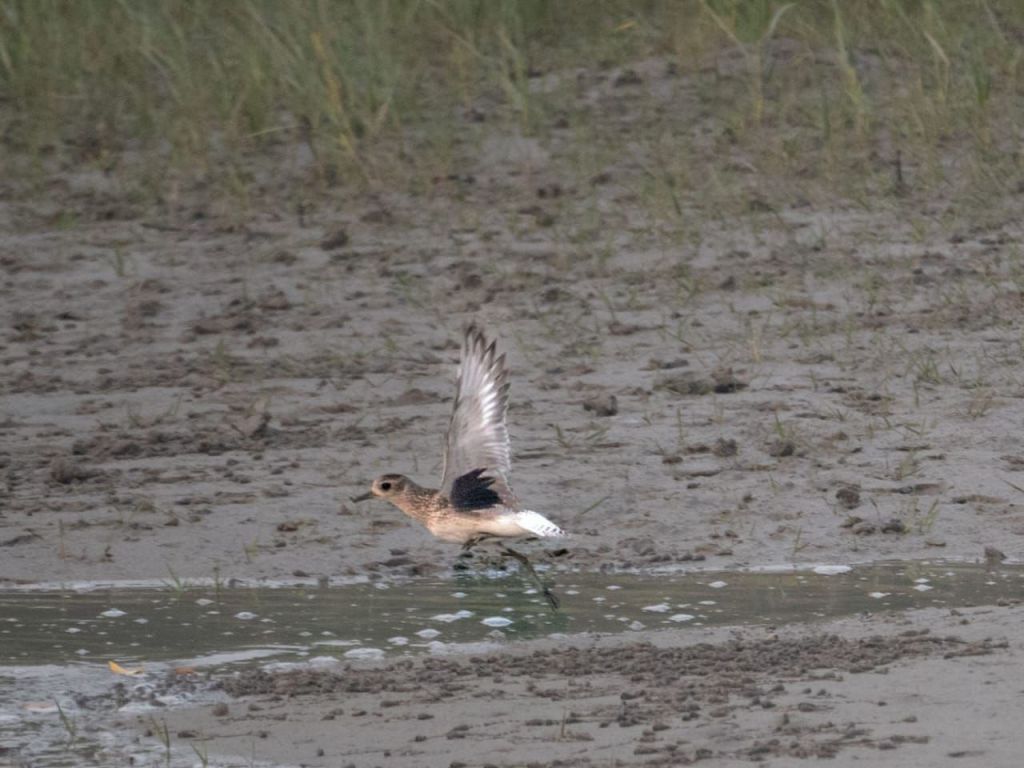
The single most reliable way to identify a Grey Plover at any time of year is during flight. Look for the distinctive black patch in its “armpit” (axillary feathers). This feature instantly separates it from the otherwise similar-looking Pacific Golden-Plover. Additionally, the Grey Plover has a noticeably thicker and heavier bill compared to other plovers.
Grey Plover Habitat and Migration Route
The habitat of the Grey Plover spans continents, showcasing its incredible adaptability to different environments.
- Breeding Habitat: The Grey Plover’s breeding grounds are exclusively on the high Arctic tundra of Alaska, Canada, and Russia. It prefers dry, rocky landscapes with low-lying vegetation like moss, lichen, and dwarf shrubs.
- Wintering & Migration Habitat: Outside the breeding season, it is almost entirely a coastal species. Its ideal habitats are sandy beaches, intertidal mudflats, estuaries, and salt marshes—environments perfectly exemplified by the Sundarbans mangrove forest. During its long migration, it may occasionally be seen at large inland lakes.
The Grey Plover’s migration route is a transcontinental journey. After breeding, it flies south to winter along the coasts of North and South America, Europe, Africa, South Asia, and Australia.
What Do Grey Plovers Eat? (Diet & Foraging)
The Grey Plover is a visual hunter, employing a classic “run-stop-peck” technique. It will stand motionless, scan the ground intently, then dart forward to snatch prey from the surface.
The diet of the Grey Plover mainly consists of small invertebrates.
- On Coastal Mudflats: It feeds on marine worms, mollusks, small crustaceans (like crabs and shrimp), and insects.
- On Arctic Breeding Grounds: Its diet shifts to include terrestrial insects like beetles and fly larvae.
While foraging during winter, they can be seen in large flocks, but individuals often maintain a small personal space as they hunt.
Nesting, Eggs, and Reproduction
Grey Plovers build their nests on the ground in open, exposed areas of the tundra. The nest is a simple, shallow scrape in the soil, sometimes sparsely lined with pebbles or bits of lichen.
- Eggs: The female lays a clutch of three to four eggs, typically around June.
- Incubation: Both parents share the duty of incubating the eggs for about 26-27 days.
- Chicks: The chicks are precocial, meaning they can leave the nest and start feeding themselves soon after hatching. They fledge (learn to fly) in about 35-45 days.
The Grey Plover in the Sundarbans
The Sundarbans is a critical wintering ground for the Grey Plover. This migratory visitor can be regularly spotted from autumn to spring.
- Where to Spot: It is most commonly seen along the vast mudflats and sandy shores of the Sundarbans Tiger Reserve, especially near the estuaries of the Matla and Thakuran rivers.
- Behavior in Sundarbans: During high tide, when their feeding areas are flooded, these birds gather in large, mixed-species flocks known as “communal roosts” on higher, undisturbed sandbars or islands.
Conservation Status and Threats
According to the IUCN Red List, the Grey Plover is listed as a species of Least Concern due to its vast global population and range.
However, this broad classification masks a worrying trend. Like many other migratory shorebirds, its populations are in decline. The primary threats to the Grey Plover include:
- Habitat Loss: The degradation and destruction of coastal wetlands at its crucial stopover and wintering sites.
- Human Disturbance: Disruption at feeding and roosting areas from coastal development and recreation.
- Climate Change: The long-term impact on its fragile Arctic breeding ecosystem.
The species is protected under international treaties like the Agreement on the Conservation of African-Eurasian Migratory Waterbirds (AEWA), highlighting the global effort needed to protect these incredible long-distance travelers.
#GreyPlover #BlackBelliedPlover #PluvialisSquatarola #Shorebirds #Waders #SundarbansBirds #Birdwatching #MigratoryBirds #BirdIdentification #WildlifeOfSundarbans #ArcticBirds #BirdFacts #Conservation
 Samiran Mandal