The Vibrant Orange-breasted Green Pigeon: A Jewel of Asia’s Forests
Quietly foraging in the canopies of tropical Asia, the Orange-breasted Green Pigeon (Treron bicinctus) is a stunning sight for any bird enthusiast. This fruit-eating pigeon, known for its vibrant colours and gentle nature, moves in pairs or small, silent flocks, blending seamlessly into the lush foliage.
Let’s take a closer look at this beautiful bird.
Identification and Appearance
At about 29 cm in length, this pigeon is a masterpiece of natural colour.
- The Male: The male is instantly recognizable by his striking plumage. He boasts a narrow lilac-pink band on the upper breast, with a broader, bright orange band just below it. The crown is yellowish-green, while the nape is a contrasting blue-grey. The undertail coverts are a distinct cinnamon or rufous colour.
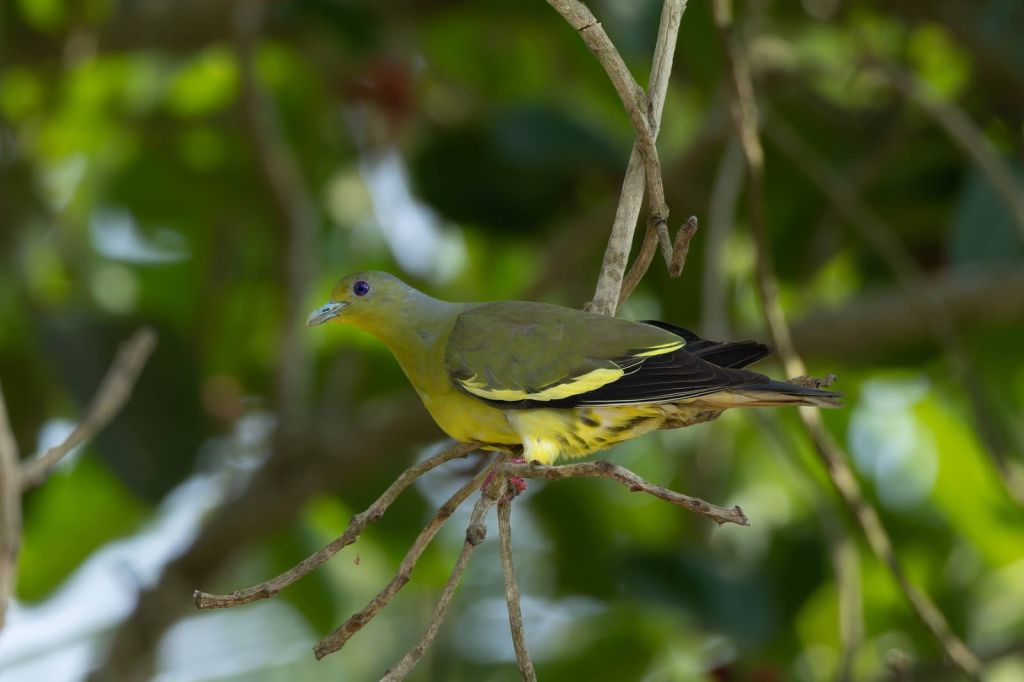
- The Female: Females are more subtly coloured, lacking the vibrant breast bands. They are distinguished by their bright yellow breast and the contrast between their brownish-to-green upperparts and blue-grey nape.
- Distinguishing Features: Both sexes have clear yellow wingbars, which help differentiate them from the similar Pink-necked Green Pigeon (which has cream-coloured bars). The Orange-breasted Green Pigeon also lacks an obvious eye-ring, another key identification feature.
Taxonomy and Distribution
The Orange-breasted Green Pigeon is a polytypic species with four recognized subspecies: leggei, bicinctus, domvilii, and javanus.
It is a resident species across a vast range, including the Indian subcontinent (from the Terai and lower Himalayas down to the Western and Eastern Ghats), Myanmar, Thailand, Cambodia, Vietnam, Malaysia, south China, Java, and Bali.
Habitat
This adaptable bird thrives in a variety of landscapes. It can be found in:
- Moist deciduous and evergreen forests
- Woodlands and rainforests
- Coastal wetlands and mangroves
- Farms, gardens, and other human-altered landscapes
Diet and Foraging Behavior
Primarily a frugivore, its diet consists mainly of fruits and seeds, with a particular fondness for figs. They are often seen joining other fruit-eating birds at fruiting trees, moving slowly and deliberately along branches to pluck fruit with their specialized bills.
Interestingly, this species is known to feed on the fruits of Strychnos nux-vomica, which are toxic to most mammals. While mainly a fruit-eater, it will occasionally consume buds, shoots, and small invertebrates. Its flight is fast and direct, marked by regular, powerful wingbeats.
Vocalisation: The Pigeon’s Song
The call of the Orange-breasted Green Pigeon is a soft, melodious, and somewhat complex series of wandering whistles and low, subdued ‘woo-woo’ sounds. During courtship, the male performs a more elaborate cooing song. These gentle calls are most often heard in the early morning and late afternoon.
Breeding and Nesting
In India, the breeding season runs from March to September, peaking before the monsoon in June. During this time, males engage in elaborate courtship displays, bowing to attract females. They can be territorial, fighting off rivals with aggressive wing-slapping and pecking.
The nest is a typical pigeon nest: a flimsy, simple platform of a few twigs, usually built in the fork of a tree. The female lays a clutch of 1-2 glossy white eggs. Both parents share incubation duties, with the eggs hatching in about 12-14 days. The chicks fledge after another two weeks but remain dependent on their parents for some time.
Conservation Status
According to the IUCN, the Orange-breasted Green Pigeon is classified as Least Concern. This is because the species has an extremely large range and a population that, while not quantified, is not believed to be near vulnerable thresholds.
However, the population trend is believed to be decreasing. This is likely linked to habitat loss, with an estimated 14.4% decline in tree cover across its range over the last three generations. While the decline is not yet rapid enough to be a major concern, it highlights the importance of conserving forest habitats to protect this beautiful species for the future.
Uddalak Das
68/3C Purna Das Road
Kolkata 700029
Orange-breasted Green Pigeon, Treron bicinctus, Green Pigeon, Birds of India, Asian Birds, Birdwatching, Ornithology, Frugivore, Pigeons and Doves, Wildlife of Southeast Asia, Conservation, Bird Identification
 Samiran Mandal
One response to “The Vibrant Orange-breasted Green Pigeon: A Jewel of Asia’s Forests”
Beautiful bird and well written article. 💚
LikeLiked by 1 person