
Back from the Brink: The Sundarbans’ Fight to Save the Northern River Terrapin (Batagur baska)
The Northern River Terrapin, or Batagur baska, is one of the most critical aquatic species in the Sundarbans mangrove ecosystem. As one of Asia’s largest freshwater and brackish water turtles, its survival is a key indicator of the region’s health. Once widespread across Southeast Asia, this species has been pushed to the edge of extinction, disappearing entirely from many of its native habitats.
Today, a groundbreaking conservation effort in the Sundarbans is writing a new chapter for the Batagur baska, pulling it back from what seemed like an inevitable disappearance.
Distinctive Features: Identifying the Batagur Baska
The Northern River Terrapin is a large and impressive turtle, making it easily recognizable if you know what to look for.
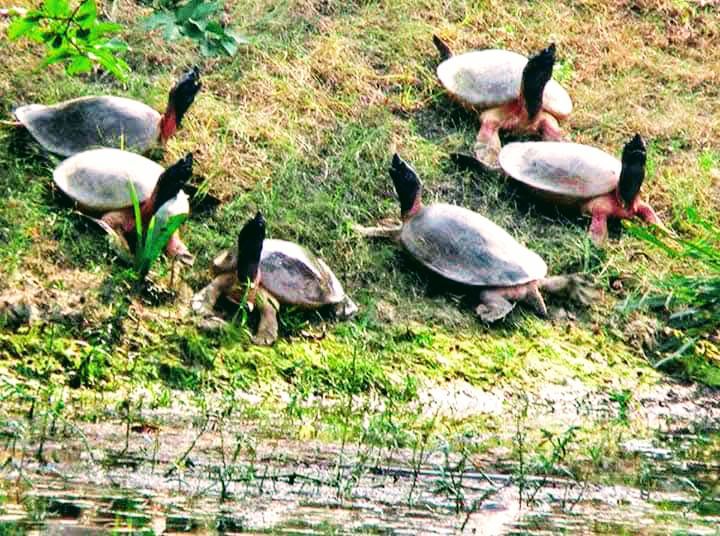
Size and Shell: It boasts a large, smooth carapace (upper shell) that can grow up to 60 cm long. The shell is typically grey or black, with a moderately depressed or flattened shape and a distinct keel (ridge) running down the center. The plastron (lower shell) is white or yellowish.
Unique Head: Its most defining feature is its upturned snout or “upper lip,” which gives it a unique profile.
Sexual Dimorphism: Females are generally larger than males, but males have a longer, thicker tail. During the breeding season, the male’s appearance transforms dramatically: his head and neck turn a deep black, while his face and the front of his legs become a vibrant orange or peach color. The male’s eyes also become yellowish, compared to the brown or grey eyes of the female and juveniles.
Four-Toed Terrapin: Unlike most other turtles that have five claws on their front limbs, the Batagur baska has only four. This has earned it the popular name, the “Four-Toed Terrapin.”
Habitat and Distribution: A Shrinking World
The Northern River Terrapin’s ideal habitat includes the coastal mangrove regions, narrow canals, and river mouths with sandy banks perfect for nesting.
Current Population: Today, wild populations are found only in India (the Sundarbans), Bangladesh, and Myanmar.
Local Extinction: It is now considered locally extinct in Thailand, Vietnam, and Singapore. It was once found in the Hooghly River in India and the Irrawaddy River in Myanmar but has long since vanished from those areas.
Functionally Extinct: In many parts of its former range, the species is considered “functionally extinct,” meaning the few surviving individuals are unable to sustain a viable population in the wild.
Threats: A Species Under Siege
The decline of the Northern River Terrapin is a direct result of human activity.
Overharvesting: The primary driver of its decline has been the insatiable demand for its meat and eggs.
Habitat Destruction: Sand mining on riverbanks destroys their nesting grounds. The construction of dams and hydroelectric projects alters river flows, making habitats unsuitable.
Fishing Practices: Modern fishing gear, especially large-scale nets, often leads to the accidental drowning of these air-breathing turtles.
Environmental Changes: Mangrove deforestation, climate change, and increasing siltation in rivers further degrade their fragile environment.
A Beacon of Hope: The Sundarbans Breeding Program
Faced with the grim reality that the species was ecologically extinct in the wild, a monumental conservation effort was launched. In 2008, the Sundarban Tiger Reserve (STR) and the Turtle Survival Alliance (TSA) initiated a captive breeding program. Starting with just a handful of individuals—some discovered in a temple pond—the project has become a world-renowned success story.
The program operates under an ex-situ conservation model, where the species is bred and raised in a protected environment outside its natural habitat. The Sajnakhali Wildlife Sanctuary in the Sundarbans is home to the main hatchery and breeding center.
From those few initial turtles, the program has flourished. By 2021, the population at the breeding center had grown to nearly 400 individuals, a record-breaking achievement. To secure this precious population, “Assurance Colonies” were established in other protected areas like Nadhopani, Baghna, and Harikhali, ensuring the species is safe from a single catastrophic event like a storm or disease.
Back to the Wild: A High-Tech Release
The ultimate goal of conservation is rewilding. In a landmark event in January 2022, ten sub-adult terrapins (seven females and three males) were fitted with satellite transmitters and released back into the wild. This project was supported by the People’s Trust for Endangered Species (PTES) and the Ocean Park Hong Kong Conservation Fund (OPHKCF).
The results were astonishing. Within six weeks, the turtles had traveled over 300 kilometers, with some crossing the international border into Bangladesh! In a fantastic example of transboundary cooperation, the Bangladesh Forest Department, with support from the Vienna Zoo, tracked and temporarily recaptured the turtles before releasing them again. This tracking data is invaluable for understanding their behavior and identifying critical habitats for future protection.
This initiative also involves local communities. Fishermen are educated on what to do if they find a tagged turtle, making them active partners in this conservation journey.
Conservation Status
The Northern River Terrapin is among the most protected species in the world:
IUCN Red List: Critically Endangered
Indian Wildlife (Protection) Act, 1972: Schedule I
CITES: Appendix I
These classifications grant it the highest level of legal protection, but its survival depends on continued, hands-on conservation work. Headstarting—raising hatchlings in captivity until they are less vulnerable to predators before releasing them—remains a vital strategy.
The future of the Batagur baska hinges on these collaborative efforts. The success in the Sundarbans proves that with dedication, science, and international cooperation, we can pull a species back from the brink and restore a vital part of our planet’s natural heritage.
Batagur baska, Northern River Terrapin, Sundarbans, Turtle Conservation, Critically Endangered Species, Wildlife Conservation, India, Bangladesh, Turtle Survival Alliance, Captive Breeding, Rewilding, Mangrove Ecosystem, Conservation Success Story, Endangered Animals
 Samiran Mandal
2 responses to “Back from the Brink: The Sundarbans’ Fight to Save the Northern River Terrapin (Batagur baska)”
Rebblog under Animal Welfare Rights thank you amen 🙏
LikeLiked by 1 person
Very nice
LikeLiked by 2 people