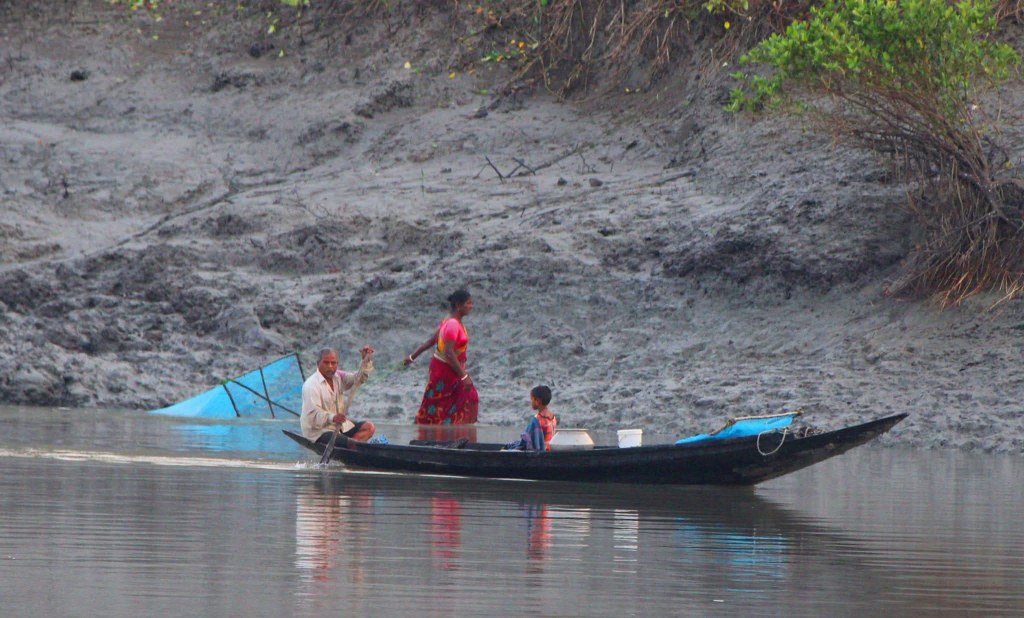
The Sundarbans, a unique ecosystem, harbors communities where matriarchal belief systems thrive, led by deities like Bonodebi, Bonobibi, and Bishalakshmi. In this tiger-infested jungle and crocodile-laden waters, daily survival is deeply rooted in mother goddess worship.
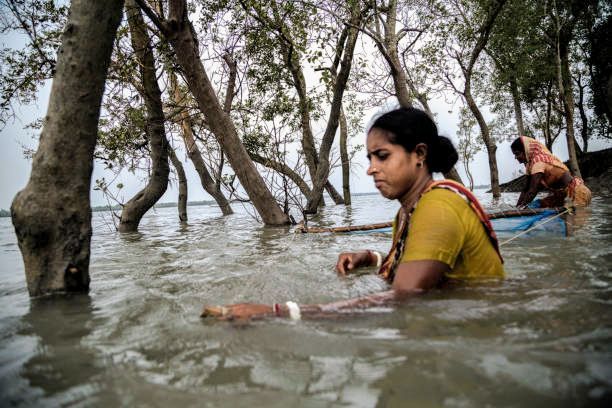
Despite this, a Sundarbans paradox exists: women’s access to the jungle is significantly limited compared to men. This is due to various factors; many jungle activities are physically demanding and risky for women. However, through firsthand accounts, it’s clear that the reality of tigers profoundly impacts Sundarbans women, albeit in distinct ways.
This article, an extension of previous discussions on tigers and human psychology, focuses on “Tigers and Women of the Tidal Forest.” It explores the courage, perspectives, and unique bond that Sundarbans women share with tigers and their jungle environment.
Sundarbans Women: Diverse Jungle Perspectives
Jungle work in the Sundarbans varies by resource: fish, crabs, honey, timber. Women’s involvement in most fishing methods is minimal. High-risk, prolonged tasks like honey collection or timber work have traditionally excluded women. Crab fishing, however, is a notable exception with significant female participation.

Here are the jungle perspectives of Sundarbans women categorized by their engagement level:
1. Village Homemakers: The Psychological Impact of Tigers
These Sundarbans women, often living near the tiger jungle, rarely encounter tigers directly, even if family members do. While sharing other forest stories, direct tiger encounters are often avoided. For them, the tiger’s ferocity is primarily psychological. Most have not seen a wild tiger and prefer not to. Yet, they universally acknowledge the tiger’s crucial ecological role in the Sundarbans. Their traditional animosity towards tigers has significantly decreased.
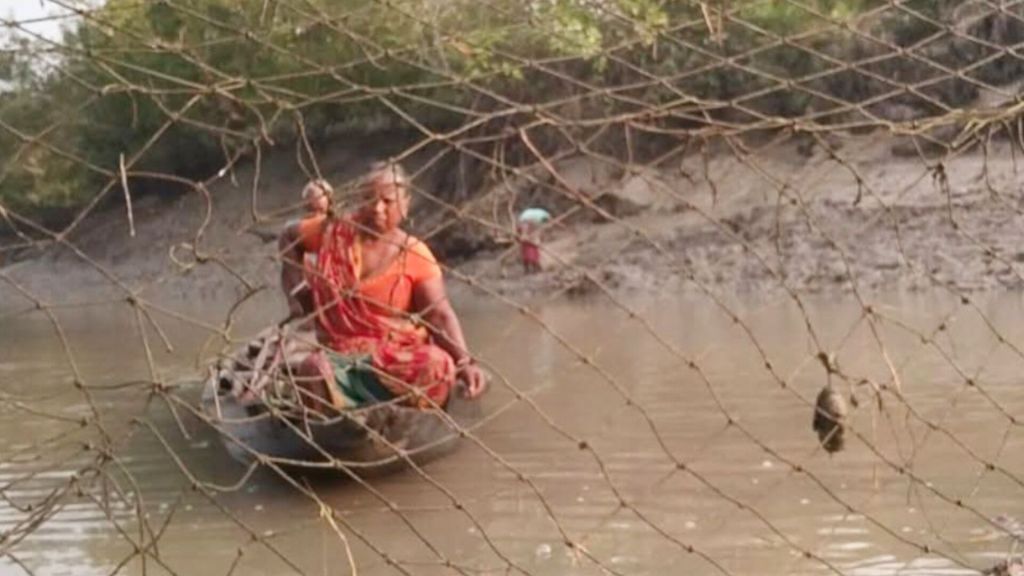
Amidst evolving village life, these women diligently maintain traditional rituals and prayers for family members engaged in jungle work. They manage local shrines and temples. Their direct tiger experiences include hearing tiger roars at night near villages, or rare glimpses of tigers that previously entered homes or gardens. They also view rescued tigers, helping them align mental images with reality. Observing tigers near net barriers, hearing nightly roars, or witnessing boats return from tiger encounters at the ghat further shapes their understanding. Many have seen sudden tiger appearances or fresh paw prints while fishing or gathering leaves. As men increasingly seek migrant work, many women now favor reduced jungle engagement, demonstrating successful conservation awareness.
2. Occasional Forest Workers: Partial Jungle Engagement
These women have an intermediate involvement with the jungle. They often hold other village jobs and join jungle expeditions with family or neighbors. Their participation involves daily fishing and crabbing from boats, without disembarking into dense forest. They have less direct tiger experience, focusing on boat-based fishing or using “don” (a type of trap) for crabs. In crabbing, they assist in setting/retrieving “donuri” or “don” from boats, or collecting/processing crabs with “jalti” (net). They frequently become privy to direct tiger encounters and other jungle experiences, similar to full-time workers. Numerous tiger-human conflict case studies show that many such women have direct, often dangerous, experiences.
3. Full-Time Jungle Dwellers: Resilient Women of the Sundarbans Forest
These women display courage and determination equal to men. Lighter builds are advantageous for navigating dense mangroves, explaining higher female participation in specific crab-catching methods. Historically, many women joined groups for bagda (tiger prawn) fry collection, experiencing conflicts with tigers, crocodiles, and “kamot” (a biting fish). Women’s participation in crabbing has since increased significantly. Highly risky “thopa” (trap) work, involving daily direct and indirect tiger encounters, presents similar dangers. Beyond “thopa,” women’s involvement in “don,” net, “beri” (another trap), or digging for crabs is notably high.
Beyond authorized daily “pashi” (licensed) boat work, many women engage in unauthorized jungle activities. In “bepashi” (unlicensed) work, besides tigers, “foresters” pose another threat. To evade patrol boats, they enter canals, hide deep in the jungle during low tide, or navigate narrow waterways for “don” work, often bringing them very close to tigers. Some women also participate equally in multi-day “pashi” boat expeditions, staying overnight in the jungle. In these groups, reactions to tigers are strikingly similar between men and women, demonstrating that full-time women jungle dwellers possess comparable courage, fear, preparedness, and risk-taking.
Evolving Traditions & Conservation in Sundarbans
Historically, women’s jungle entry and work were not permitted by traditional beliefs. Socially, their participation in timber, honey, or “khalpata” (leaf collection) was unrecognized. Thus, despite a matriarchal social structure and devotion to mother goddesses, restrictions on women’s involvement in jungle-dependent livelihoods persisted.
Jungle life is delicate; rules were established for men and women to maintain restraint, given inherent dangers and physical demands. Concerns about exertion, menstruation, and women’s vulnerability in danger were considered valid. However, these perceptions have gradually relaxed, leading to increased women’s presence in the forest, initially through simpler activities like net fishing along rivers.
My extensive experience across the Sundarbans, encountering “Babule” or “Gunin” (shamans/medicine men), indicates that even experienced mantra experts often favor retaining old rules for jungle work. Most skilled, middle-aged fishermen and “Baules” (traditional collectors) overwhelmingly prefer all-male groups. Notably, the forest department also exclusively employs men for field duties in core “Tigerland.” Conversely, in tourism or remote, less-equipped areas, women’s participation in jungle-related work is more accepted. Across the tiger jungle interface, social approval for women’s jungle involvement is more liberal. Lastly, in socio-economically disadvantaged communities, these rules are more relaxed; in more advanced sections, female participation is traditionally lower and continues to decline.
 Samiran Mandal
40 responses to “Sundarbans Women: Lives Intertwined with Tigers & Jungle – An In-depth Look”
🕊️ Soul to soul bond🤝 Bond beyond years
LikeLiked by 2 people
Most Welcome 🌸
LikeLike
Absolutely fascinating. What an amazing borderland between sea and land. Interesting to find out the role of women and changes.
LikeLiked by 2 people
Thanks 🙏
LikeLiked by 1 person
Welcome
LikeLike
Dear Samiran
It is a rare moment in life to read your post.
Thank you 🙏
Thank you for liking my post, ‘Daughters’ 😊🙏
LikeLiked by 3 people
That’s an inspiring read. I’m moved by the Sundarbans women’s courage and their evolving bond with the tigers and the mangrove ecosystem.
LikeLiked by 3 people
You are most welcome!
LikeLike
Fascinating contrast! 🌿 The Sundarbans’ deep reverence for mother goddesses highlights strength and survival, yet the paradox of women’s limited access reveals a powerful story of resilience and change. 🐅🌊
LikeLiked by 3 people
Thank you for your like.Because in my WordPress reader/user account, post titles always remain. safiadigitaltechandwellnes.com And the prompt topic is my blog post; if you click “read more,” it will redirect to my blog, and if you click my title, it will redirect to my website. Kindly read my entire post each time, as that will be a great help to me. If you also leave a comment, I would be even more grateful to you.
LikeLike
The Mother Goddess worship pairs well with the relationship to the tigers. They live in a very dangerous environment and adaptations are key. It’s an impressive write up. Thank you for sharing this with your community.
LikeLiked by 4 people
This is a very insightful article that highlights the complexity of women’s lives in the Sundarbans and their relationship with such a dangerous yet crucial ecosystem. It’s interesting to see how tradition and religion coexist with the practical demands of daily survival and jungle work. Despite historical restrictions, women are gradually participating in forest activities, showing courage and involvement on par with men—especially in crab-catching and other tasks requiring direct engagement with nature. The article clearly illustrates that changes in social perceptions of gender roles are slow but happening, often driven by both economic necessity and growing environmental awareness.
LikeLiked by 4 people
Very interesting.
LikeLiked by 4 people
Well written and informative post and great photos ~ thanks,
LikeLiked by 4 people
Fascinating post, Samiran. I am fascinated by tigers.
LikeLiked by 4 people
Same here. 😊
LikeLike
There is so much to Sunderban, Thanks
LikeLiked by 3 people
Very nice!
LikeLiked by 3 people
Thanks 🙏
LikeLiked by 2 people
Fascinating read. The courage and resilience of Sundarbans women in such harsh conditions is truly inspiring.
LikeLiked by 3 people
Thanks
LikeLiked by 1 person
Absolutely amazing read of these woman and the work they do and the dangers around them . Thank you for sharing.
LikeLiked by 3 people
Thanks 🙏
LikeLiked by 1 person
I found the post informative and interesting, and the photos beautiful
LikeLiked by 1 person
Thanks for your compliment
LikeLiked by 1 person
You’re welcome!
LikeLiked by 1 person
A tiger, under the current economic system, where they are mainly found in the jungle, the jungle of “zoo”, codified under “zoology”, meaning prominent in a cage, on display, sold, ultimately to the least common denominator,
A faculty, a distinguished faculty, wanting to give the tiger its rightful place.
LikeLiked by 2 people
Valuable opinion 🙏 thanks 👍
LikeLike
Very insightful post.
You highlighted the Sundarbans paradox well.
The bond between women and tigers is fascinating.
I liked how you connected courage and survival.
Crab fishing exception was an interesting point.
Well-written and thought-provoking piece.
LikeLiked by 2 people
Thanks for your valuable opinion
LikeLike
Dear Samiran
It is a beautiful post. Thanks.
Thanks for liking my post, Ulysses 🙏
LikeLiked by 2 people
Welcome 😊
LikeLiked by 1 person
Most Welcome
LikeLiked by 1 person
Thanks 👍
LikeLike
There’s something spectral in how these women move through the Sundarbans — praying to the tiger they rarely see, yet feeling its breath in the dark. Their lives are half ritual, half survival, a quiet treaty with the forest itself. Every roar, every paw print is a reminder that the jungle is watching, and that their courage is as much spiritual as it is physical. 🐅🙏
LikeLiked by 1 person
Thanks for your valuable opinion 👍
LikeLiked by 1 person
Hi Samiran,
Thanks for visiting and liking some posts.
You have taken some great photos. 😇
Some of your work reminds me of one of my old school friends, Salam.
He is the author and photographer of “Bangladesh Diaries”.
Have a good weekend.
Amani!
LikeLiked by 1 person
Thanks for your valuable comments
LikeLike
Inspiring read ❤️
LikeLiked by 1 person
Thanks
LikeLike