
The Tiger of the Conscious and Subconscious Mind
The perception of the tiger in the Sundarbans is shaped by two distinct realities: the direct and the indirect. The tiger of direct experience is a manifestation of our conscious mind, constructed through sightings from afar or up close, observation, and the various signs and tracks left in the forest and on the water. This world is physically present and has a tangible periphery.However, there is another world of the tiger—a manifestation of the subconscious mind. This realm is shaped by fear, anxiety, apprehension, and the influence of other events. It is a little-explored perspective, often remaining unknown to most due to the constraints of travel itineraries.Today’s discussion focuses on this tiger of the subconscious.

The Narrative of the Tiger Across Generations
In villages adjacent to the tiger’s forests and among forest-dependent communities, the tiger is a recurring subject. Tales of its strength, appearance, and ferocity are woven into daily conversations. Similarly, stories of its intelligence, stealth, and prowess circulate when a tiger strays into village territories.On average, about twenty percent of the people in the Sundarbans depend on the forest for their livelihood. For the majority, although they grow up in the tiger’s domain, direct encounters are limited. As a result, the collective narrative of the tiger is transmitted orally from one generation to the next.Today, it is widely understood that the tiger is both the supreme inhabitant and the greatest protector of the mangrove forest. Even so, conversations about the tiger reveal multiple concepts, metaphors, and symbols in the human mind. Alongside its terrifying and ferocious nature, its importance and role have also found a place in the subconscious. Simultaneously, the forest is no longer seen merely as a collection of resources; its connection with the rural populace and the non-renewable nature of its assets are now clearly understood.Perhaps this is why, despite the death, disability, and financial ruin caused by tiger attacks, villagers still plead for a chance to see a captured tiger or touch its body. This desire stems from the awe and mystery surrounding the animal, a phenomenon through which the human-tiger equation in the Sundarbans continues to evolve. Added to this is the arrival of outside guests, whose curiosity is largely dominated by the tiger, its stories, and related experiences. Consequently, in the era of tourism and wildlife ecotourism, the people of the Sundarbans see the tiger not just as an animal, but as the center of an economic model that is now clear to them.
The Mental Impact of a Direct Encounter (PTSD)
How does a direct encounter with a tiger affect the subconscious? Numerous accounts reveal that although the moment of a sighting is brief, its psychological scars can last a lifetime. Survivors often report sleep disturbances, loss of appetite, and recurring flashbacks of the tiger’s face and roar when they close their eyes or are in the dark. In most cases, the treatment for this Post-Traumatic Stress Disorder (PTSD) either never begins or is abandoned midway.There are instances where individuals, though physically unharmed, have suffered such severe mental trauma that they became mentally unstable or died prematurely. The helplessness, and the vivid memories of the dead or injured, remain fresh in the minds of eyewitnesses, neighbors, and even the closest relatives of the victims. In psychological terms, many of these issues remain largely unresolved, with emotions like fear, respect, anger, resentment, and sorrow becoming paramount.
The Metaphor of the Tiger in Dreams and Culture
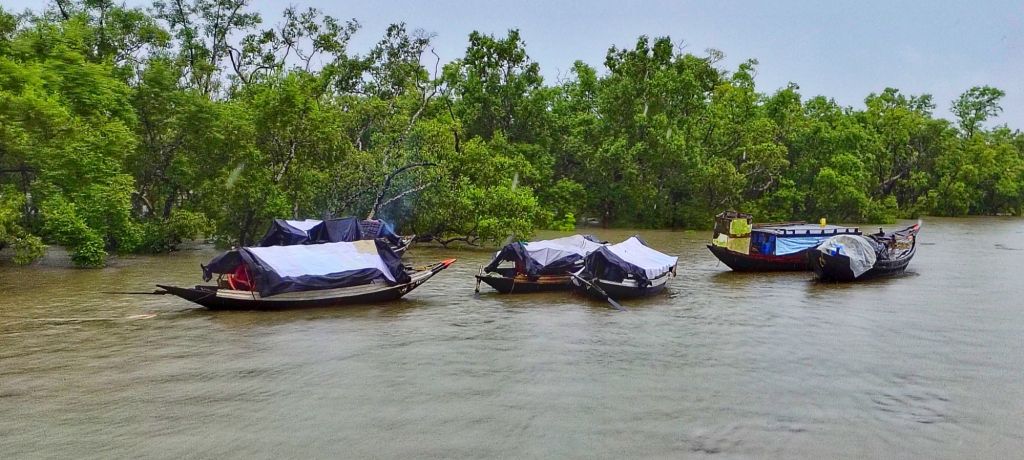
Those who work in the forest may talk about deer, birds, or wild boars, but they rarely share stories of tiger encounters at home. Their experiences thus remain unspoken. Similarly, for their family members, work in the forest is a source of anxiety, but they never fully grasp how the tiger occupies the minds of their loved ones.On a forest-going boat, the tiger is an ever-present entity, whether in reality or in dreams. Fishermen, crab collectors, and their families often interpret a dream about a tiger before a journey as an omen; the tiger becomes a metaphor for danger. This often leads to the postponement of the journey or a change in the route. Sometimes, forest-goers share such dreams with their team, and at other times, they do not. The leader of the boat might keep his dream a secret to maintain the crew’s morale. In post-conflict discussions, it is often believed that an unshared “dream-command” was a harbinger of misfortune.It is not just the tiger; figures from folklore such as Bonbibi (the forest goddess), Dakshin Rai (the tiger god), and Begho (spirits of the tiger-eaten) are recurring motifs. Through these beliefs, philosophies of danger, fate, and restraint become prominent in the subconscious mind. Both Hindu and Muslim communities worship Bonbibi before entering the forest, believing she protects them from tiger attacks.
The Tiger’s Presence in the Village Psyche
Historically, certain corridors in the Sundarbans have higher records of tigers straying into human settlements. Conversations with people in these villages reveal that the tiger is not merely a ferocious animal but a symbol—it is both the greatest connection and the greatest source of anxiety between nature and humans. When a tiger’s presence increases in an area, the “Lombafokir” (a local name for the tiger, meaning ‘the tall ascetic’) repeatedly occupies the people’s minds, dreams, conversations, and rumors. Phrases like, “The tiger doesn’t cross this way anymore,” “The tiger is on the move,” or “The tiger might cross over now,” help in understanding its place in the psychology of these forest-adjacent villages.In villages where this problem has been mitigated, perceptions about the tiger have changed. Conversely, where the problem persists, a sense of familiarity with the danger has developed. Through long-term coexistence, people have structured their mental landscape to include the tiger.
Conclusion
Exploring the tiger and the subconscious mind brings forth many such dimensions. Its influence extends across both the conscious and subconscious realms. Although people maintain a physical distance from the yellow-and-black striped animal of the forest, the idea of the tiger has flowed continuously for generations in many villages of the Sundarbans. While information, perceptions, and speculations about it change with time, this magnificent creature remains intricately woven into the minds of the Sundarbans’ people—in their beliefs, aspirations, fears, dreams, and reverence.
 Samiran Mandal
17 responses to “The Tiger and the Subconscious Mind: The Influence of the Tiger on the Psyche of the Sundarbans People”
This highlights the profound, intergenerational impact of the tiger on the conscious and subconscious minds of the local people. Interesting ✨
LikeLiked by 1 person
Thanks and welcome
LikeLiked by 1 person
Samiran, your piece stirred something deep for me. Though I never face the tiger in my daily life, it has always been present—in the media of my youth, in the imagination of a visual arts teacher, even in the year of my birth, 1962, the Year of the Tiger. For me it remains a beautiful threat, a mystery that stalks the mind more than the body.
Reading your words, I wonder—among those who live in the Sundarbans, is awe stronger than fear, or are the two so intertwined that they cannot be separated?
LikeLiked by 2 people
Thanks for your valuable comments 🙏
LikeLike
If there is an encounter with a tiger, what generally happens? Does it attack? Does it run? Or is it not possible to generalise?
LikeLiked by 1 person
will answer all your questions slowly and request you to see the previous posts on this topic, thank you.
LikeLiked by 1 person
Intriguing concept! 🐅🧠 The parallel between the majestic Sundarbans tiger and the layers of the human mind is both profound and thought-provoking. 🌿✨
LikeLiked by 1 person
Well said, thanks 🙏
LikeLike
Fascinating read, I felt like I was with in reach of the stories in real life. I can imagine the power and the intensity of the presence of a tiger and you expressed it with such detail of how the villagers experience it in so many different profound ways , it brings the tiger to life with the photos and stories and so much more understanding of what follows in the paw prints of a tigers world.
LikeLiked by 1 person
Thank you for this profoundly insightful and enlightening article! I greatly appreciate how you have successfully delved into the tiger’s influence on the subconscious mind of the Sundarbans community, extending beyond mere physical sightings. As Safia Begum expressed, the concept you convey is truly ‘intriguing’ and ‘thought-provoking’, showing a deep parallel between the majestic tiger and the layers of the human mind. I also agree with Grafmr that the tiger is a ‘beautiful threat’ and ‘mystery that stalks the mind more than the body’, and this article brilliantly elaborates on how awe and fear are intricately intertwined, shaping the community’s identity and aspirations. Emotions of empathy, admiration, and a desire to understand this complex relationship radiate clearly from your writing. I hope this piece further broadens our understanding of the need for holistic approaches to conservation, which also consider the psychological and cultural dimensions of communities living alongside wild nature.
LikeLiked by 1 person
Thanks for your elaborate and valuable opinion 👍
LikeLike
nice article
LikeLike
Thanks 👍
LikeLiked by 1 person
Creo que los humanos también funcionamos por esa dualidad,: la visible y la invisible: Freud, la memoria animal persiste en nuestro cerebro y nos condiciona, Y esa dicotomía nos hace humanos, porque nosotros lo sabemos y podemos controlar nuestros instintos más primarios,
LikeLiked by 1 person
Thanks for your valuable comments 🙏
LikeLiked by 1 person
Nice article 💯
LikeLiked by 2 people
Thanks pk once again
LikeLike