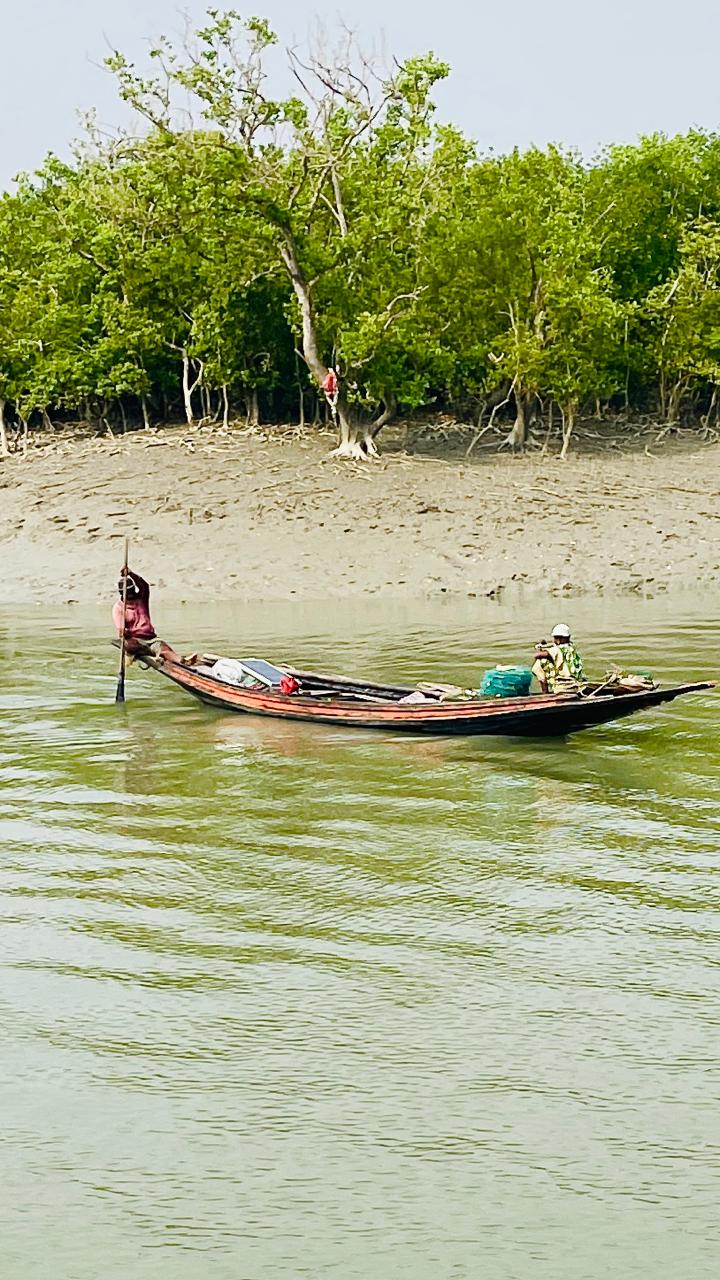
A Poetic Narrative of Life and Loss in the Sundarbans
Here, the water moves, the jungle sways, the wind whispers secrets,
The breathing roots listen quietly to it all, life here lives and dies.
Days begin in the same rhythm, gauging the tide’s rise and fall,
Two calloused hands, scarred by oars, tremble with each stroke.
Rahim and Amina—their names like waves written on water,
Their world—this mangrove forest, unknown to anyone else.
Together they cast nets at dawn, when fog adorns the water,
Together they paddle their small boat through narrow creeks, with boundless courage.
Amina’s hand holds the oar firmly, her eyes fixed on distant bends,
Rahim cuts the water with his oar in rhythm, relying on his wife’s call.
Their home—the boat’s deck, a floating raft,
Livelihood means daily neglect, facing death’s door.
Calloused hands, shoulders touching—yet little time for words,
Eyes speak everything, weariness and breath fade.
As the afternoon light slants down, salt-crusted rice is shared,
Rahim might offer a fish, Amina extends her hand.
It’s not that they don’t quarrel, sharp as the salty water,
But soon affection grows, clouds clear, light shines again.
Caring for each other—it’s as natural as breathing,
If Amina’s sari hem gets wet, Rahim becomes an anxious traveler.
He searches for a torn cloth to cover her, though his own body is bare,
When Rahim hesitates at a creek’s mouth, Amina understands the net is heavy with tangles.
“Be careful paddling”—a rough voice, yet full of unspoken love,
“You look ahead first”—in this alone, the body finds reassurance.
They know tigers lie in wait behind the hetal trees,
Crocodiles gape in the sun on the banks, waiting for an opportunity.
Yet they must go—for hunger’s demand knows no prohibition, no fear,
Returning in the evening, having gambled life, is also a wondrous victory.
Sometimes darkness falls suddenly, a storm rages madly,
Then the two draw closer, love dispels fear.
That day, the morning was like any other—calm, tranquil,
Only the birds’ calls were fewer, a different color in the sky.
They were returning along a narrow creek, their boat almost full of fish,
Suddenly, the nearby bush stirred, a dry tree trembled.
In a flash—like a bolt of lightning, yellow-black stripes—
Laft to the boat’s edge, aiming for Rahim—the ill-fated one!
Before Amina could understand, it was all over—a sharp cry,
And then no sound—only a soft splash in the water… gone.
Everything else was still, silent. Rahim was gone… gone… only—
A few drops of blood on the deck, which had not yet dried.
The tiger vanished into the jungle, its prey in its mouth,
As if nothing had happened, this water-forest washes away all memories.
Amina sat like a stone, the oar firm in her hand,
Only his last helpless glance floated before her eyes.
This water, this jungle—which she had loved with her husband,
Today they took everything, left her alone on this cursed night.
The boat feels impossibly heavy today, the oar like a mountain,
Salty water mixes with tears, a song of sorrow breaks from her chest.
Caring? For whom will she care now? Who will care for her?
Those calloused hands are so alone today, a hollow ache in her chest.
Yet she lifts the oar again, turns the boat towards the bank,
Life doesn’t stop, it shouldn’t—Rahim himself had taught her.
In the fading light of life. She must live, fight on,
Only a salty bond within her heart has broken forever.
The wind blows as before, but in that wind today is the smell of death,
Amina must paddle alone, carrying a broken life-song in her heart.
Exploring Themes of Resilience and Nature’s Power
This evocative poem paints a vivid picture of existence in the Sundarbans, a region where the line between survival and peril is constantly blurred. Through the intertwined lives of Rahim and Amina, the narrative delves deep into the bond forged by shared struggle, love, and the unforgiving embrace of nature. The daily routine of fishing, navigating treacherous waters, and confronting the wild’s dangers becomes a testament to human spirit.
The tragic turn of events, a sudden tiger attack, serves as a stark reminder of the unpredictable forces that govern life in this unique ecosystem. Amina’s subsequent journey of solitary endurance highlights themes of grief, strength, and the relentless continuation of life even in the face of insurmountable loss. The “salty bond” of the title can be interpreted as not only the literal saltwater environment but also the unbreakable connection between the couple and their deep-rooted ties to their homeland, a bond ultimately severed by tragedy but also redefined by survival.
 Samiran Mandal
11 responses to “Breaking the Salty Bond”
nice post
LikeLike
Thanks 🙏
LikeLike
Beautiful poem, unfolding the harsh truth of life.We have to move on even after our loved ones are gone.
LikeLiked by 1 person
Thanks for your valuable comments 🙏
LikeLike
Samiran!!! What a brilliantly moving and heartbreaking narrative. It masterfully captures the harsh beauty and unforgiving rhythm of life in the Sundarbans, making the sudden loss of Rahim feel like a brutal tear in the very fabric of nature. The contrast between their tender, wordless love and the jungle’s cold indifference is devastating.
Wow… Plz would love more such deep moving poems ✌️ keep them coming -🙌🤝😇
LikeLike
Thanks for your valuable comments 🙏
LikeLiked by 1 person
Always samiran!
Keep the poetry coming
LikeLike
Beautiful poem; the imagery is amazing
LikeLiked by 1 person
Thanks for your compliment 🙏
LikeLiked by 1 person
Nice read
LikeLike
Heartbreaking.
LikeLiked by 1 person