Tiger Stripes: More Than Just Ornamentation
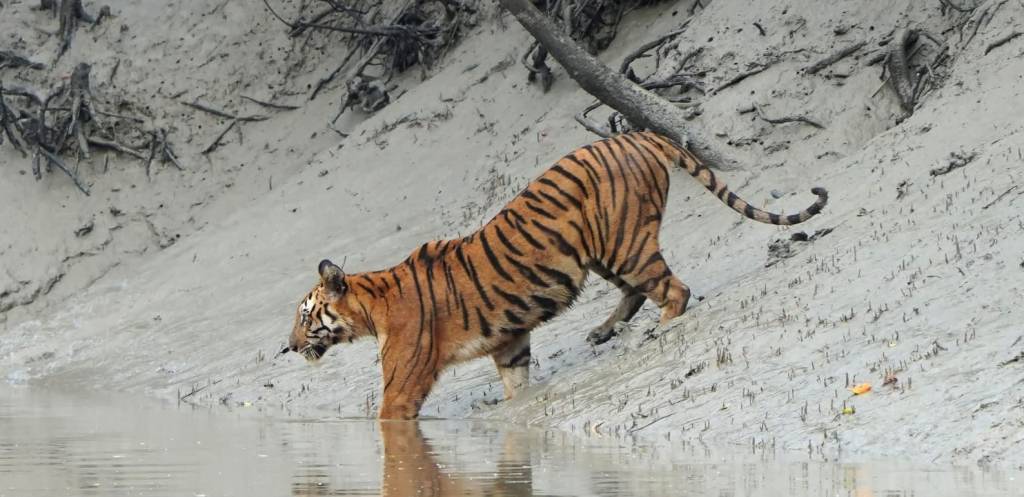
A tiger’s stripes are not merely decorative; they are a vital tool for survival. In the folklore of the Sundarbans (the “Badar”), the stripe is a recurring motif—a fleeting golden-black shimmer amidst the dense mangrove thickets.
These stripes also play a role in thermoregulation, as the lighter areas of the coat can reflect heat. These patterns develop as the tiger grows, creating a unique “biological barcode” for every individual. Interestingly, the pattern is not just on the fur; it is etched into the skin itself, meaning even if a tiger were shaved, it would still display its characteristic stripes.
3. The Science of Camouflage: The Art of Being Invisible
A tiger’s stripes serve as its primary stealth weapon. To prey animals like deer and wild boar, who possess dichromatic vision (perceiving mainly blues and greens), the tiger’s orange-yellow coat appears as a muted grayish-green. This allows the predator to blend seamlessly into the forest floor.
The vertical lines break up the tiger’s silhouette, a phenomenon known as “disruptive coloration.” By shattering the body’s outline against the play of light and shadow in the brush, the tiger achieves an optical illusion that allows it to remain invisible until the final “stealth charge.” This is why, in the Sundarbans, neither man nor beast can easily detect a tiger’s approach.
4. Unique Identifiers and Population Science
While there is no fixed number of stripes, most tigers have over 100.
Bengal Tigers: Usually average around 100 stripes.
Sumatran Tigers: Possess the narrowest and most dense stripes.
Malayan Tigers: Generally have a lower stripe count.
Because these patterns are as unique as human fingerprints, conservationists use them as unique identifiers in camera trap images to track populations, monitor health, and study gene flow across wildlife corridors.
5. Communication and Genetics
Beyond camouflage, stripes are a medium of social signaling. They help tigers identify each other for mating or territorial boundary setting. Cubs recognize their mothers through these distinct patterns.
From a biological standpoint, these patterns are a result of complex Gene Expression. This involves regulatory DNA sequences like promoters and enhancers. Scientists study these through RNA sequencing (RNA-seq) to understand how “housekeeping genes” and differential expressions create such intricate functional patterns in the tissue.
6. The Cultural Legacy of the Sundarbans
In the communities bordering the Sundarbans, the tiger is a figure of awe and terror. The Sundarban tiger often has darker, thicker stripes and a deeper orange hue compared to its mainland relatives. In the “Hental” (Palm) forests, this color palette makes the tiger a “ghost”—often referred to by locals as the “Thief” (Chor) for its uncanny ability to vanish behind a single branch.
7. Taxonomy and the Concept of ‘Cline’
In tiger morphology, four out of five subspecies exhibit a “Cline”—a biological gradient where physical traits change based on geography. Generally, as you move from North to South, tigers become smaller, and their coloration becomes darker.
The Malayan Tiger (Panthera tigris jacksoni) is the exception. While it looks similar to the Indochinese tiger, it is classified as a distinct subspecies based on genetic sequencing (mtDNA and microsatellite sequences) rather than purely physical clinal variations.
 Samiran Mandal
6 responses to “Tiger Stripes: The Hidden Science of Survival and Stealth”
This is fascinating. I love that I can learn something (or in this case lots of things) every day. Thank you!
LikeLiked by 1 person
Welcome 😊
LikeLike
I learn so much about tigers reading your blog.
LikeLike
Thanks for your compliment
LikeLiked by 1 person
Fascinating, as always.
LikeLike
Thanks
LikeLiked by 1 person